Charge Capture and Documentation: The Foundation of Accurate Revenue
Blog post description.
3 min read
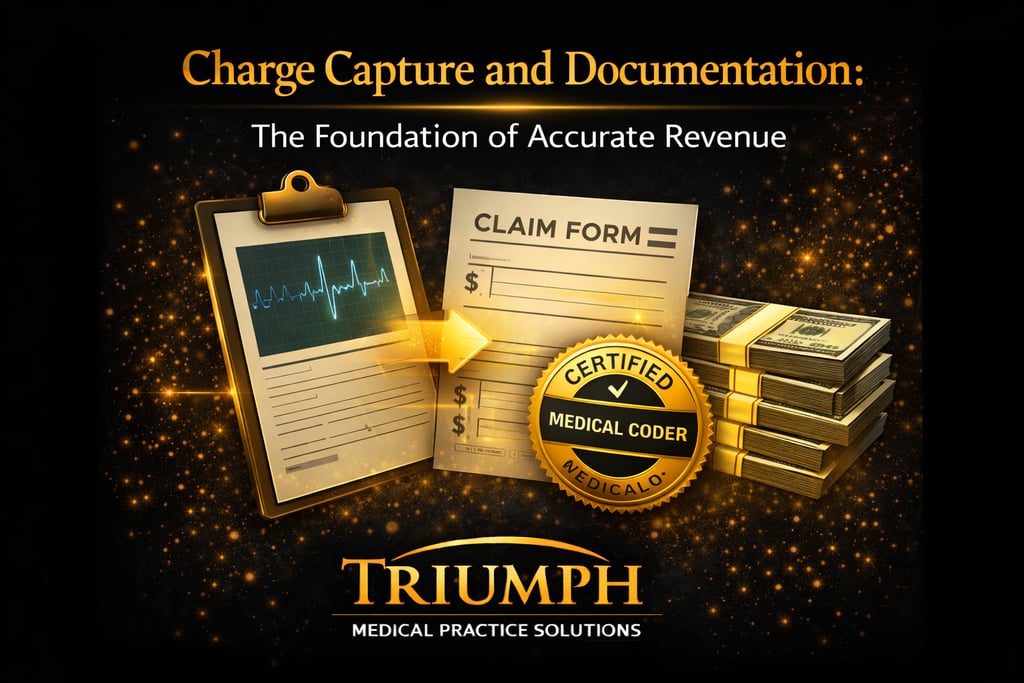
In the world of revenue cycle management (RCM), accuracy isn’t just a goal—it’s a safeguard. Every claim, every code, and every piece of documentation contributes to the financial health of your practice. But when charge capture and documentation are inconsistent, incomplete, or incorrect, revenue leaks through the cracks—and compliance risks start to rise.
Strong charge capture starts with understanding the value of accuracy at every step. And maintaining it requires both a consistent process and certified professionals who know how to do it right.
What Is Charge Capture—And Why It Matters
Charge capture is the process of recording all billable services provided by a physician or healthcare professional so that the practice can receive appropriate reimbursement.
When done correctly, it ensures that no service goes unbilled, undercoded, or miscoded. But when there are gaps—missed charges, incorrect modifiers, or incomplete documentation—the result is the same every time: lost revenue and potential compliance exposure.
Even one missed charge per provider per day can add up to thousands of dollars in annual losses. And errors don’t just impact the bottom line—they can trigger payer audits, delays, or recoupments that disrupt your entire revenue cycle.
Documentation: Your First Line of Defense
Accurate documentation is more than a compliance requirement—it’s the foundation of every clean claim. Each note, order, and procedure entry should tell the complete story of the patient encounter.
Strong documentation should:
Support the medical necessity of services.
Match the CPT and ICD-10 codes assigned.
Clearly identify provider actions and decision-making.
Include all details required for payer-specific rules.
When documentation is thorough and consistent, it reduces the chance of denials and supports the full reimbursement your services deserve.
Incomplete or vague documentation, on the other hand, opens the door to miscoding, underpayment, or worse—a payer audit.
Certified Coders: Your Accuracy Advantage
Certified coders and billers are the backbone of precise charge capture. They’re trained to understand the complexity of medical coding systems, payer policies, and documentation standards.
Here’s what certified professionals bring to the table:
Expert Code Application: They ensure that each service is coded correctly according to the latest guidelines and payer rules.
Audit Readiness: Certified coders recognize the documentation elements that auditors look for, reducing compliance risks.
Denial Prevention: With deep knowledge of coding combinations, modifiers, and payer edits, they prevent claim rejections before submission.
Education for Providers: Coders can train clinical teams on documentation best practices, bridging the gap between medical care and financial outcomes.
In short, certified coders don’t just handle data—they safeguard your revenue and your reputation.
How Documentation and Charge Capture Work Together
Documentation drives coding, and coding drives billing. When one is weak, the entire chain is at risk.
A well-defined charge capture process should include:
Clear SOPs: Defined steps from provider documentation to code assignment to charge entry.
Checks and Balances: Routine internal audits to confirm documentation matches billed services.
Communication Loops: Open dialogue between providers, coders, and billers to resolve discrepancies quickly.
Technology Integration: EHR systems that prompt for missing data and support clean data transfer to billing.
When everyone understands their role in this process, accuracy becomes second nature—and preventable errors become rare.
The Cost of Getting It Wrong
A single coding or documentation mistake may seem small, but multiplied across hundreds of encounters, the impact can be enormous. Under-coding leaves money uncollected; over-coding risks audits, penalties, and payer scrutiny.
Beyond the financial loss, poor charge capture erodes trust—between departments, with patients, and with payers.
The cost of doing things almost right is always higher than the investment in doing things completely right from the start.
Audits as Opportunities
Internal audits should be viewed as improvement tools, not punishment. Regular reviews of documentation, coding, and charge capture processes help you catch trends early—before payers do.
Certified coders play a critical role here too. They know where to look, what to flag, and how to correct issues without disrupting workflow.
An effective audit program does more than protect you from errors—it strengthens your systems, your training, and your long-term financial stability.
Final Thoughts: Precision Protects Your Practice
Strong documentation and accurate charge capture form the foundation of every healthy revenue cycle. They protect your income, ensure compliance, and give leadership the confidence that every service is being billed correctly and defensibly.
With certified professionals leading the charge, your practice doesn’t just stay compliant—it stays competitive.
Success starts with structure—and a team trained to use it.
Contact Triumph Medical Practice Solutions at 214-305-8805 to strengthen your RCM through certified coding expertise and smarter charge capture.